Do I Take Responsibility for My Mistakes Quickly, or Do I Deflect?
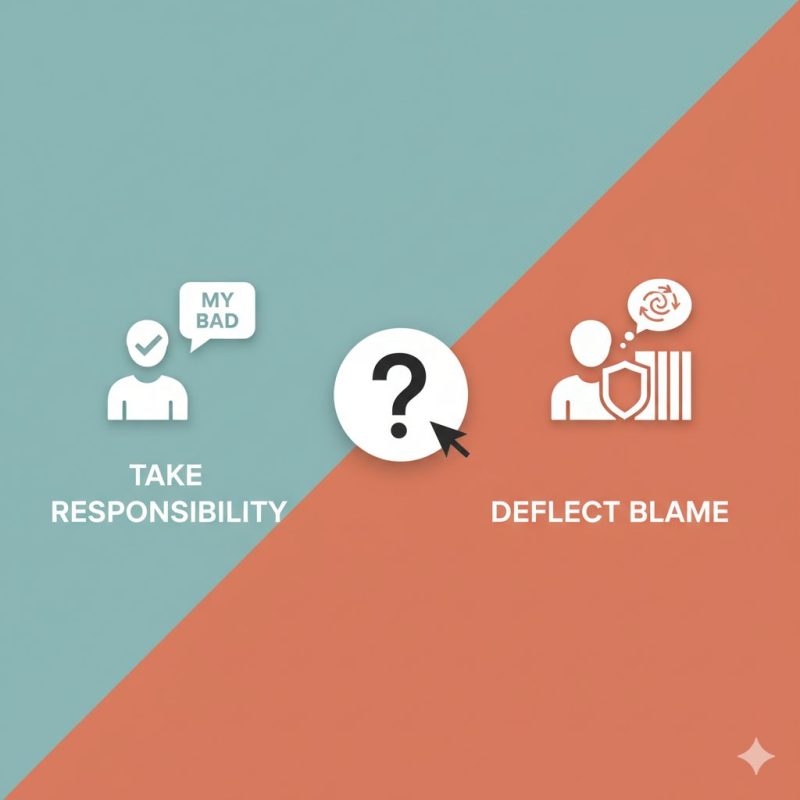
It happens to everyone. The project has a flaw, the deadline is missed, or the crucial piece of information was overlooked. In that moment—that stomach-sinking second when the mistake is revealed—you have a choice. Do you stand up and say, “My bad,” or do you start building a defensive wall of excuses and blame?
The answer to the question in the title is more than a simple matter of character; it’s a pivotal professional skill that shapes how others view your reliability, integrity, and potential for growth.
The High Cost of Deflection
It can be tempting to deflect. It’s a natural human instinct to avoid discomfort or embarrassment. We might say:
- “That was a bad instruction from the client.” (Blaming the client.)
- “If Susan had gotten me that data sooner, it would have been fine.” (Blaming a colleague.)
- “The system failed/the software glitched/the wind blew wrong.” (Blaming an external force.)
While these excuses might offer a temporary shield from scrutiny, they come with a high price tag.
- Erosion of Trust: When you deflect, your colleagues and supervisors see someone who is prioritizing their ego over the team’s success. It signals that you are not a safe bet when the pressure is on.
- Stalled Growth: Deflection stops the learning process dead in its tracks. If you can’t own the mistake, you can’t analyze why it happened or what process needs to change. You’re guaranteeing the error will be repeated.
- Wasted Time: The energy spent crafting a believable deflection is energy that could be spent on damage control, problem-solving, and developing a fix.
The Power of Immediate Ownership
Conversely, taking swift responsibility is one of the quickest ways to earn respect and establish yourself as a leader, regardless of your title. When you own a mistake, you’re not admitting you’re incompetent; you’re demonstrating maturity and control.
Here’s why quick ownership works like a superpower:
1. It Changes the Conversation
When you lead with, “I made a mistake, and here’s what I think happened,” you immediately shift the focus from who is to blame to what is the solution. The moment you own it, the impulse for others to point fingers usually dissolves because the accountability question has been answered. Take Responsibility for Mistakes
2. It Builds Unbreakable Credibility
Ironically, people trust you more when you admit a flaw than when you pretend to be perfect. Why? Because it shows honesty, self-awareness, and confidence. An immediate admission says, “I know I messed up, but I’m strong enough to handle the fallout and fix it.”
3. It Kickstarts the Fix
The faster you own the mistake, the faster you can move to the most important part: the resolution. A template for taking responsibility should sound something like this:
“I want to take responsibility for [specific error]. I realize this has caused [specific consequence]. Right now, my focus is on [Action step 1] and [Action step 2] to correct it. What feedback do you have on my proposed fix?”
Notice that this approach isn’t just an apology; it’s an apology paired with a plan for action.
The Habit to Build
Taking responsibility isn’t an occasional event; it should be a habit. The next time you feel that urge to justify or deflect, take a deep breath and ask yourself this single question:
“Is defending my ego more important than solving this problem and maintaining my reputation?”
Almost always, the answer will be no. The path to long-term success isn’t paved by people who never make mistakes; it’s paved by people who own their mistakes quickly, learn from them effectively, and demonstrate the strength of character to be relied upon, even when things go wrong.
Take Responsibility for Mistakes. Be the person who owns it, fixes it, and moves forward wiser.
Book Your Free Discovery Call Today
Or, come join the Northman Legacy Crew on Facebook.
Listen in to the Living by Oak Values Podcast — real talk, real tools, every week.
What’s your best strategy for taking ownership of a mistake in a professional setting? Share your thoughts in the comments!
This isn’t just about saving your marriage. It’s about leading your life. Book your Free Discovery Consultation now. No pressure. No pitch. Just truth, clarity, and a real path forward.
Or connect with our growing brotherhood in the Northman Legacy Crew Facebook group.