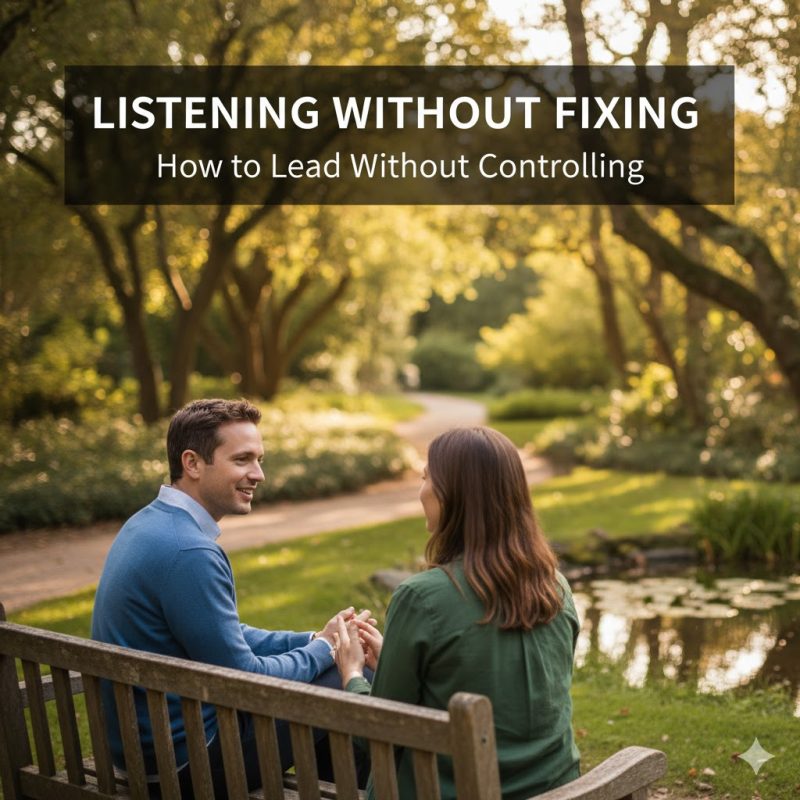
Listening Without Fixing: How to Lead Without Controlling
Why Listening Without Fixing Matters
Imagine this: It’s a Tuesday night. You walk in the door after a long day. Your daughter, eyes glossy, mutters something about a rough day at school. You shift into “dad mode”—ready to solve it. Before you even let her finish, you’re rattling off solutions: “Just ignore them.” “Tell your teacher.” “You’ll be fine.” She sighs. Shrugs. Walks away.
No hug. No connection.
That moment right there? It’s where many men lose the plot—not because they don’t care, but because they think fixing is love. What she needed was something else: listening without fixing, and leading without controlling
It’s not weakness. It’s leadership.
Or maybe You walk in and it’s your wife who is sitting at the table, quiet but heavy. She starts talking—something about feeling off, worn thin, maybe unseen. You can feel her pain, and your instinct kicks in. You start fixing: “Just take a break.” “Don’t let it get to you.” “You’re overthinking it.”
She nods, half-listening. The space between you thickens.
That moment right there? That’s where a lot of men miss it—not out of apathy, but out of love misplaced. We think fixing is helping. But what she really needed was something deeper: listening without fixing.
That’s not passivity. That’s strength. It’s leadership.
The Myth of the “Problem-Solving Man”
We’ve been told for years that good men provide solutions. That love looks like fixing, guiding, doing. But most of the time, especially in relationships, that’s the opposite of what’s needed.
When you jump in with answers, it sends the message:
“I don’t trust you to handle this.”
“I need this solved to feel okay.”
“This makes me uncomfortable, so let’s make it stop.”
Real strength is sitting in the mess with someone, not trying to clean it up right away. That’s what your partner and kids are hungry for—emotional presence, not control.
What Listening Without Fixing Actually Looks Like
Listening Without Fixing means you pause your instinct to solve. You ask questions like, “What do you need right now?” or “Want me to just listen or are you looking for ideas?” You hold eye contact. You lean in. You let them cry, vent, or just be.
It’s about being present without trying to steer the outcome. And when you get this right, something beautiful happens—they start to open up more. Because they feel safe. Heard. Loved.
Leading With Emotional Presence, Not Control
A man who leads without controlling is magnetic. He doesn’t dominate. He listens. He guides by example. He doesn’t lecture—he lives his values out loud. He knows his strength isn’t in being the loudest voice in the room but in being the calmest.
When you lead this way at home, your kids start watching more closely. Your partner begins trusting more deeply. You become the man they want to follow—not the one they feel managed by.
Common Traps That Kill Connection
Just listening can feel uncomfortable. You might think:
-
“If I don’t fix it, I’m failing them.”
-
“They’re upset—must be something I did.”
-
“I don’t know what to say!”
These are traps. Emotional defensiveness. Most of us were never shown how to just sit with someone’s feelings without absorbing or fixing them. But this is a skill—and like any skill, it can be learned.
The Benefits of Holding Space at Home
When you start holding space, your home changes. Your partner starts sharing more. Your kids start looking you in the eye again. Conversations go deeper. The noise inside your own head gets quieter.
You build connection by allowing emotions to breathe—not by shutting them down. This is how you rebuild trust after a fight, or reconnect after a divorce. It’s how you lead without controlling.
How to Practice Listening Without Fixing Every Day
-
During check-ins with your kids, try saying, “Tell me more” instead of “Here’s what to do.”
-
When your partner vents, ask, “Do you want advice or just an ear?”
-
Journal about moments you wanted to fix and didn’t—reflect on what happened instead.
-
Create quiet moments where you don’t need to fill the space.
You’ll be surprised how much more peace you’ll feel when you stop trying to steer every conversation.
When You Fall Back Into Fixing—And You Will
You’re going to slip. That’s okay. The key is recognizing it. Say something simple like, “I caught myself fixing again—can I start over and just be here with you?”
That small moment of self-awareness is powerful. It teaches your family that you’re learning, too. That you’re growing. And that their experience matters more than your ego.
Because being present is the true measure of manhood—not how many problems you can solve.
Conclusion
Why Listening Is the Strongest Form of Leadership
The men who lead their families well don’t do it by controlling every detail. They lead by listening. They make space for emotion, discomfort, and silence. They earn trust through presence.
How Northman Coaching Helps You Build This Skill
At Northman Coaching, we teach men how to stop trying to fix everything—and start showing up as the grounded leaders their families need. Through values-based coaching, we help you shift from reaction to presence, from control to connection.
Book Your Free Discovery Call Today
This kind of leadership doesn’t come from a book. It comes from honest conversation and support. Let’s talk about where you are and how you can start living with clarity and purpose.
👉 Schedule your free consult with Northman Coaching
You’re Not Alone—Let’s Talk
Whether you’re in the middle of a separation, struggling as a dad, or just tired of surviving—it’s time to lead differently.
👉 Join our Facebook Community – Northman Legacy Crew
👉 Listen to the Living by Oak Values Podcast
FAQs
Q: What does it mean to listen without fixing?
A: It means showing up fully, hearing someone out, and allowing their emotions to exist without offering advice or solutions unless asked.
Q: Why is this so important in relationships?
A: Because people—especially partners and kids—often want connection, not correction. Listening creates safety and trust.
Q: How do I know when to give advice or just listen?
A: Ask directly: “Would you like help thinking through this, or would you like me to just listen?” That question alone builds connection.
Q: I’m a fixer. Is it too late to change?
A: Not at all. Every man can learn to slow down, hold space, and build deeper relationships. Northman Coaching can guide you.
Q: What if I slip up and start fixing again?
A: That’s normal. Just pause, own it, and start again. Growth isn’t perfection—it’s consistency.
Q: How can I practice being present?
A: Start with five quiet minutes a day. Listen. Breathe. Be with your thoughts without solving them. Presence is built like a muscle.